
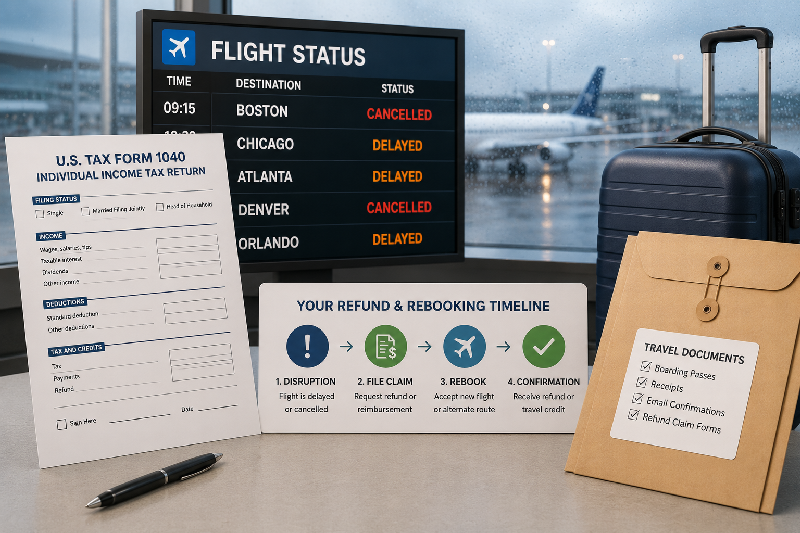
Flight cancellation and delay problems have recently affected thousands of travelers across the United States. Severe thunderstorms, crowded airspace, air traffic control restrictions, and aircraft positioning problems have disrupted schedules at major airports, including New York LaGuardia Airport and Boston Logan International Airport.
The total number of delayed flights may make headlines, but the practical question is simpler: What should you do if you are flying soon?
A disruption at one airport can spread across the country. A plane delayed in Chicago may arrive late in New York, causing another flight to depart behind schedule. Crews may also reach their working-time limits. By evening, a weather problem that started hundreds of miles away can affect your trip.
This guide explains how to check your flight, choose safer booking options, protect connections, understand refund rights, and reduce the cost and stress of a disrupted travel day.
What Has Changed for U.S. Travelers?
Recent summer storms have caused large numbers of cancellations and delays at airports across the country. New York-area airports have been especially vulnerable because LaGuardia, John F. Kennedy International Airport, and Newark Liberty International Airport share busy regional airspace.
Boston Logan has also experienced storm-related interruptions. Other major hubs can create ripple effects when thunderstorms reduce runway capacity or force the Federal Aviation Administration to slow incoming traffic.
The most important point is that airport conditions can change quickly. A flight showing “on time” in the morning may be delayed later if the aircraft or crew is arriving from another disrupted city. Travelers should therefore check more than the local weather forecast.
How to Check Whether Your Flight Is at Risk
Do not rely on a single flight-status screen. Use several sources because each one answers a different question.
| Source | What It Tells You | When to Check |
|---|---|---|
| Your airline’s app | Your flight status, gate, aircraft changes, and rebooking choices | Starting one day before departure and repeatedly on travel day |
| FAA National Airspace System Status | Ground stops, ground delay programs, airport closures, and broad air traffic restrictions | Before leaving home and when delays begin |
| Airport website | Local alerts, terminal information, parking, road conditions, and airport-wide updates | Before traveling to the airport |
| National Weather Service | Storm warnings and severe weather near your departure, connection, and arrival airports | One to three days before travel and again on departure day |
Also check where your aircraft is coming from. Many airline apps show the inbound flight. If your plane is still sitting at an airport affected by storms, your departure may be at risk even when the official status still says “on time.”
Should You Still Go to the Airport?
In most cases, yes. A delay is not the same as a cancellation. Airlines may shorten or remove a delay if conditions improve, and passengers who arrive late can still be treated as no-shows.
Go to the airport unless the airline has canceled your flight, confirmed a major schedule change, or instructed you not to travel. Allow extra time because storms can also create traffic, parking shortages, long customer-service lines, and crowded security checkpoints.
For a domestic flight, arriving about two hours before departure remains a reasonable starting point. For an international flight, plan for roughly three hours. Add more time when the airport has issued a weather warning, when you must check bags, or when you are traveling with children.
At LaGuardia, confirm your terminal and ground transportation plan before leaving. At Boston Logan, check roadway, parking, and terminal updates because heavy travel demand can create problems even when your flight is operating.
How to Book a Flight With Less Disruption Risk
You cannot control the weather, but you can choose an itinerary that gives you more options.
Book an Early Flight
The first flights of the day often have a better chance of leaving before thunderstorms build and before delays spread through the airline’s network. Early flights also leave more same-day rebooking options if something goes wrong.
Choose a Nonstop Flight When Practical
Every connection creates another opportunity for a delay. A nonstop ticket may cost more, but it can be worth the difference when you are traveling for a cruise, wedding, international flight, or time-sensitive event.
Avoid the Last Flight of the Day
If the final flight is canceled, you may have to wait until the next morning. Earlier departures provide more backup choices.
Use One Ticket for Connecting Flights
When both flights are on the same reservation, the airline generally has more responsibility for rebooking you after a missed connection. Separate tickets can be risky because the second airline may treat you as a no-show if the first flight arrives late.
How Much Connection Time Should You Allow?
The airline’s minimum connection time is not always a comfortable connection time. During a period of widespread flight delays, build in a larger cushion.
| Connection Type | Practical Time to Consider |
|---|---|
| Domestic to domestic at a familiar airport | At least 75 to 90 minutes |
| Domestic connection at a very large hub | About 90 minutes to two hours |
| International arrival requiring customs and re-screening | At least three hours, and sometimes more |
| Separate-ticket connection | Several hours or an overnight stay |
These are planning cushions, not guarantees. Airport layout, terminal changes, security lines, immigration, checked baggage, and mobility needs can all increase the time required.
For an expensive cruise or international departure, arriving in the departure city one day early may be the safest choice. The hotel cost can be far lower than the cost of missing the trip.
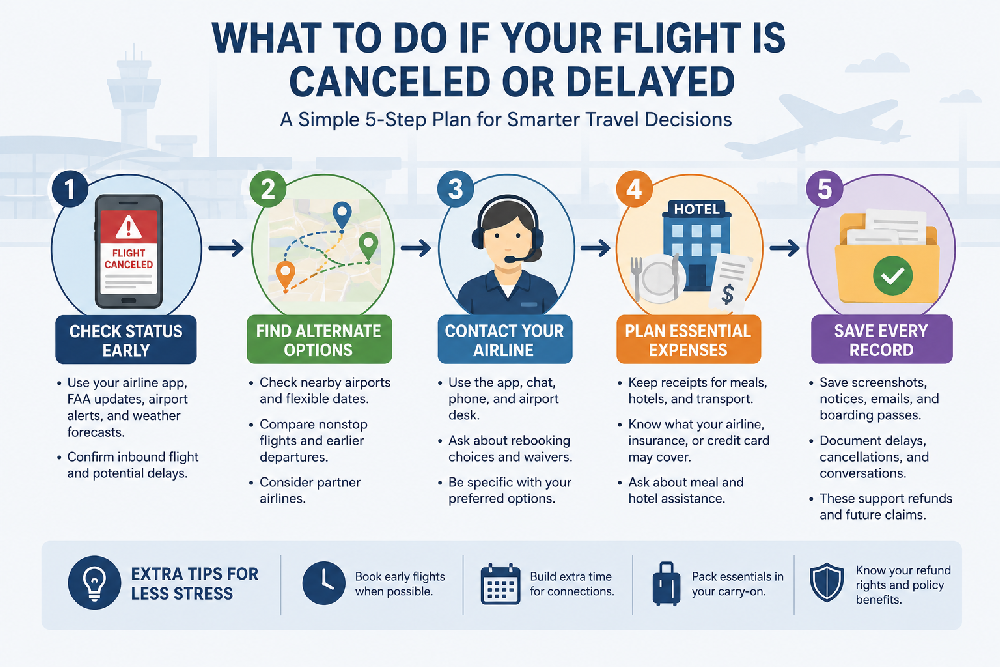
What to Do as Soon as Your Flight Is Canceled
Act quickly. Available seats on later flights can disappear within minutes.
- Open the airline app. Look for automatic rebooking choices before standing in a customer-service line.
- Search for alternate airports. In New York, consider whether JFK, Newark, LaGuardia, Philadelphia, or a nearby regional airport could work.
- Call while waiting in line. Use the app, phone support, chat service, and airport desk at the same time if possible.
- Ask about partner airlines. Some carriers may place passengers on another airline, although this is not always available.
- Do not cancel the booking too quickly. First confirm whether you want a refund or a replacement flight.
- Save records. Keep screenshots, delay notices, receipts, boarding passes, and messages from the airline.
Be specific when speaking with an agent. Instead of asking, “What can you do?” say, “I found an available flight tomorrow at 7:10 a.m. through Chicago. Can you place me on that itinerary?”
Refunds, Vouchers, Meals, and Hotels
Under U.S. Department of Transportation rules, you are generally entitled to a refund when an airline cancels your flight or makes a significant schedule change and you decide not to accept the replacement transportation.
This can apply even to a nonrefundable ticket. However, once you accept and use the replacement flight, you usually cannot also demand a refund for the original ticket.
Cash compensation for a domestic weather delay is different. U.S. airlines are generally not required to pay passengers simply because a flight is delayed or canceled. Meal, hotel, and transportation benefits often depend on the cause of the disruption and the airline’s customer-service commitments.
If the airline caused the problem, such as a maintenance or crew issue, it may provide meals, hotel lodging, or ground transportation. If severe weather caused the cancellation, those benefits are less likely.
Before accepting a travel voucher, check whether you are entitled to a cash refund. A voucher may have an expiration date, restrictions, or limited value for your future plans.
Can Travel Insurance Help?
Travel insurance may cover certain costs caused by a qualifying delay or cancellation, but the details matter. Policies often require a minimum delay period and may only cover listed reasons.
Possible covered expenses include:
- Meals during a long delay
- A hotel near the airport
- Transportation between the airport and hotel
- Nonrefundable bookings missed because of a covered disruption
- Replacement transportation in some situations
Coverage limits and exclusions vary. A policy bought after a storm is already forecast may not cover that storm. Credit cards with travel protections may also provide delay or baggage benefits when you used the card to pay for the trip.
Keep itemized receipts. A credit-card statement alone may not show what you purchased.
A Simple Disruption Cost Example
Suppose a family of three has an overnight cancellation. They spend $220 on a hotel, $75 on meals, and $50 on transportation.
Total disruption cost: $220 + $75 + $50 = $345
If a travel policy covers up to $150 per traveler for a qualifying delay, the potential benefit could be as much as $450. The family’s $345 of eligible expenses may therefore fit within the limit, but reimbursement would still depend on the policy terms, documentation, and reason for the delay.
What to Pack in Case of a Long Delay
Keep essential items in your carry-on. Checked bags may become difficult to retrieve during a cancellation.
- Prescription medicine
- Phone charger and portable battery
- One change of clothes
- Basic toiletries
- Snacks and an empty water bottle
- Travel documents
- Items needed by children
For international travel, keep passports, visas, medication, and valuable electronics with you. Do not place them in checked baggage.
Frequently Asked Questions
Can an airline cancel a flight after passengers board?
Yes. Weather, mechanical issues, crew limits, or air traffic restrictions can cause a cancellation even after boarding. Keep your airline app active and watch for rebooking options immediately.
Does a ground stop mean my flight is canceled?
No. A ground stop temporarily prevents certain flights from departing for an affected airport. It can lead to a delay, but flights may resume when the restriction ends.
Should I rebook before the airline officially cancels my flight?
Check whether the airline has issued a travel waiver. A waiver may allow you to change dates or airports without the normal change fee or fare difference. Without a waiver, changing voluntarily could cost more.
Will the airline pay for my hotel after a weather cancellation?
Often not. Airlines are less likely to cover lodging when weather or air traffic conditions caused the cancellation. Ask anyway, check the airline’s published commitments, and review any insurance or credit-card protection.
What happens to my checked bag?
The bag may be transferred to your new flight, held at the airport, or sent to baggage claim. Ask the airline before leaving. Do not assume the bag will automatically follow your new itinerary.
Final Travel Planning Advice
Recent flight cancellation and delay events are a reminder that the cheapest itinerary is not always the safest itinerary. A very short connection, late-night departure, or separate-ticket booking may save money at first but create larger costs when weather disrupts the system.
Before traveling, check your airline, the FAA, the airport, and the weather. Choose earlier flights when possible. Build extra time into important connections. Keep essential items with you, and understand whether you want rebooking or a refund before accepting an airline’s offer.
Most delays eventually end, but prepared travelers have more choices. A few extra checks before leaving home can save hours at the airport and reduce the chance that one canceled flight ruins the rest of the trip.
References
- Federal Aviation Administration National Airspace System Status — Provides current information about ground stops, delay programs, airport closures, and major air traffic restrictions.
- FAA Daily Air Traffic Report — Supports guidance on checking expected weather and air traffic impacts before travel.
- U.S. Department of Transportation Refund Guidance — Explains passenger refund rights after airline cancellations and significant schedule changes.
- DOT Airline Cancellation and Delay Dashboard — Lists airline customer-service commitments for controllable cancellations and delays.
- LaGuardia Airport Alerts and Advisories — Provides official local notices and links to current flight and airport updates.
- Boston Logan International Airport Flight Status — Provides official arrival and departure information for Logan travelers.