
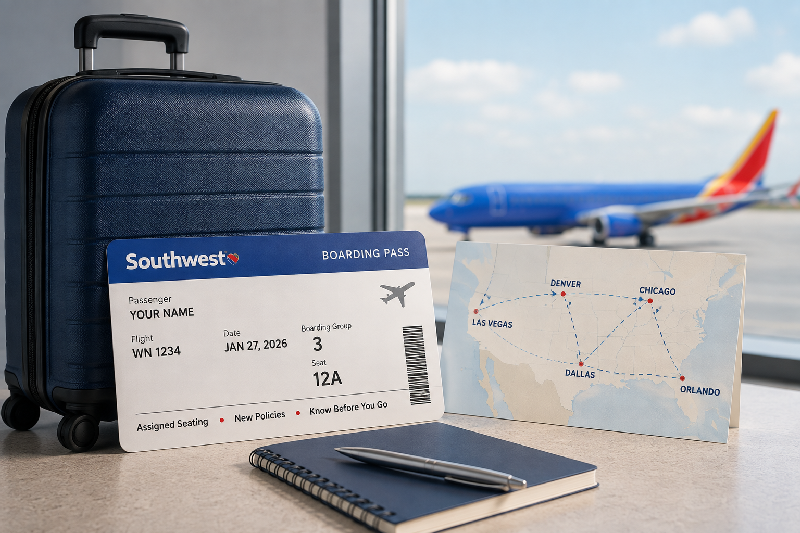
Southwest Airlines no longer uses the open-seating system that once made its flights different from most major U.S. carriers. Passengers now receive assigned seats, and the airline uses numbered boarding groups instead of the familiar A, B, and C lines.
That change affects much more than where you sit. Your fare type can now determine whether you select a seat while booking, receive one at check-in, board early, or pay extra for a better location. Southwest has also updated its policy for passengers who need an additional seat, creating new questions about advance purchases, availability, and refunds.
Before booking, travelers should separate confirmed rules from social media rumors. Here is what the current Southwest passenger seating changes mean for families, budget travelers, passengers who need extra space, and anyone deciding whether a higher fare is worth the cost.
What Changed With Southwest Seating?
Southwest switched from open seating to assigned seating for flights departing on or after January 27, 2026. Under the old system, passengers chose any available seat after boarding. An early boarding position was important because it improved the chance of finding an aisle, window, or nearby family seat.
Under the current system, boarding early does not give you permission to take any open seat. Your boarding pass displays a specific seat, and that seat remains yours unless Southwest changes the aircraft or another operational issue requires reassignment.
The airline also replaced A, B, and C boarding positions with Groups 1 through 8. Boarding order now depends on factors such as your fare, assigned seat category, elite status, and eligible Southwest credit card benefits.
| Old Southwest system | Current Southwest system |
|---|---|
| Open seating after boarding | A specific seat is assigned or selected before departure |
| A, B, and C boarding groups with numbered positions | Boarding Groups 1 through 8 |
| Earlier boarding improved seat choice | Earlier boarding mainly improves overhead-bin access |
| Most seats were treated similarly | Standard, Preferred, and Extra Legroom categories are offered |
How Southwest Seat Selection Works by Fare
The cheapest fare may not provide the same level of control as a higher-priced ticket. Travelers should compare the total package rather than looking only at the first price shown in search results.
Basic
Basic passengers generally receive a Standard seat when check-in opens 24 hours before departure. If Southwest cannot assign a seat immediately, the passenger may receive the assignment at the gate.
A Basic ticket can still be a sensible choice for a solo traveler who does not care about sitting near the front. It may be less attractive for couples, families, or travelers who strongly prefer an aisle or window.
Choice
Choice fares include selection of an available Standard seat during booking. These seats have standard legroom and are generally located farther back in the cabin.
This fare can offer a useful middle ground. You gain more control than with Basic without automatically paying for a premium seat category.
Choice Preferred
Choice Preferred includes access to available Preferred or Standard seats. Preferred seats have standard legroom but are located closer to the front.
The main travel benefit is convenience rather than added space. Sitting near the front can shorten the time needed to leave the aircraft, which may help when you have a tight connection or need to reach ground transportation quickly.
Choice Extra
Choice Extra includes selection of an available Extra Legroom seat or another available seat. Extra Legroom locations are generally near the front or in eligible exit rows and can provide several additional inches of seat pitch, depending on the aircraft.
This fare may be useful for taller passengers, travelers who value personal space, or people who want a more predictable premium seating experience. Exit-row rules still apply, so not every traveler can use every Extra Legroom seat.
What the New Boarding Groups Actually Mean
Assigned seating reduces the need to stand near the gate long before boarding. Your seat will not disappear because another passenger enters first.
However, boarding order still matters when a flight is full. Passengers in later groups may have fewer choices for overhead-bin space. A carry-on bag could be checked at the gate if the bins fill before you board.
Earlier boarding may therefore matter most to travelers carrying fragile items, work equipment, medicine, or belongings they do not want separated from them. Travelers with only a personal item may have less reason to pay for a boarding upgrade.
Do not assume that a rumored gate practice has become official policy. Confirm your group on your boarding pass and follow the instructions displayed in the Southwest app or announced by gate agents.
What Families Should Know Before Booking
Families should no longer rely on the old family-boarding process as their main plan for sitting together. Seat assignments now matter more than the order in which the family enters the plane.
Travelers on Choice, Choice Preferred, or Choice Extra fares can select eligible seats during booking. That makes it easier to confirm that a child and adult are next to each other before arriving at the airport.
Basic-fare seats are assigned at check-in or, in some cases, at the gate. Southwest says it will work to place children age 12 or younger next to at least one accompanying adult when seats are limited. However, that does not necessarily mean the entire family will sit in one row.
For example, two adults traveling with two children might receive two pairs of seats in different rows rather than four seats together. Families who need a specific arrangement should consider selecting seats in advance instead of depending on last-minute assistance.
How the Extra-Seat Policy Works
Southwest maintains a policy for customers whose bodies extend beyond the armrests and require the use of part of an adjacent seat. A passenger can purchase an additional seat in advance to help ensure that enough space is reserved.
Advance purchase is now more important because assigned seating limits the airline’s ability to create an adjacent open space at the last minute. A passenger who arrives without an additional reservation may receive a complimentary extra seat only when adjacent seats are available. The assigned seat type may also need to change.
Southwest does not allow travelers to purchase multiple seats simply to guarantee an empty seat for comfort or privacy. The extra-seat process is intended for qualifying space needs and certain approved situations, not as a general way to block a neighboring seat.
Can the Extra Seat Be Refunded?
A purchased extra seat may qualify for a refund, but the refund is not automatic in every case. Southwest’s current rules can depend on factors such as whether the flight departed with an open seat and whether the itinerary included a partner airline.
Passengers should keep both confirmation details and submit the refund request through Southwest after travel. An extra seat on an itinerary involving a partner carrier may be nonrefundable, so this should be confirmed before purchasing.
Anyone who depends on the additional space should contact Southwest before travel rather than waiting until boarding. Ask the representative to verify that both seats are correctly linked and adjacent.
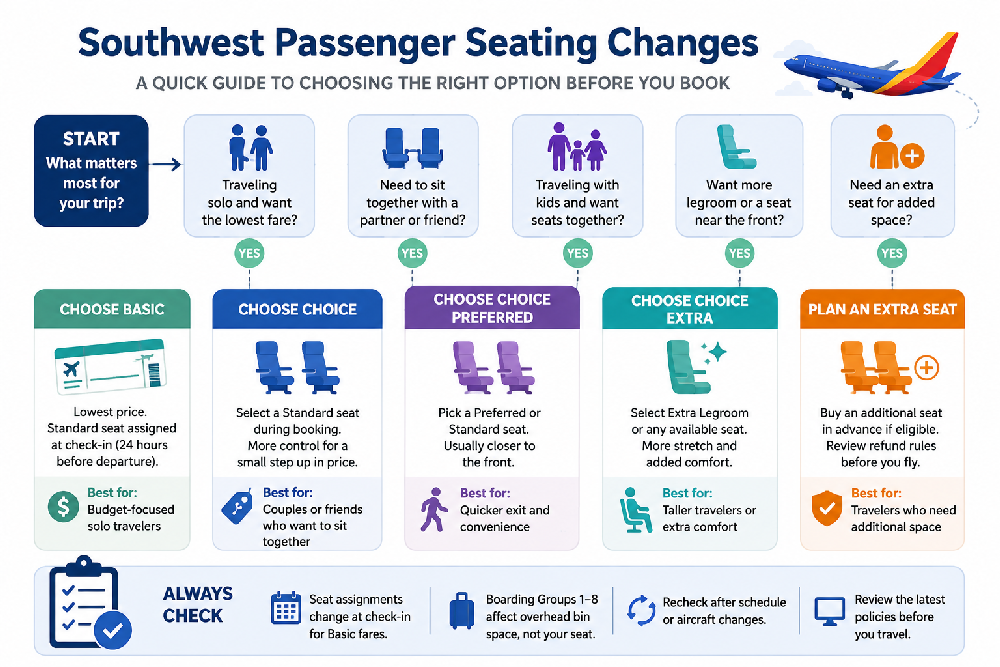
Should You Pay More to Choose a Seat?
The answer depends on what could go wrong if you do not choose one.
| Traveler | Practical booking approach |
|---|---|
| Solo traveler with no seat preference | Basic may be enough if the lowest price is the priority |
| Couple wanting to sit together | Choose a fare that allows seat selection or pay for seats |
| Family with young children | Select adjacent seats during booking when possible |
| Tall passenger | Compare Choice Extra with the separate Extra Legroom seat price |
| Traveler with a short connection | A Preferred seat near the front may save deplaning time |
| Passenger needing an extra seat | Reserve it in advance and verify the refund terms |
Consider the entire trip. Paying more for a front-row location may have little value on a nonstop leisure flight with no schedule pressure. The same seat could be valuable when a delay leaves you with a 35-minute connection.
What to Check After You Have Already Booked
Open your reservation in the Southwest website or app and confirm the following:
- Your seat number appears for every flight segment.
- Travel companions are assigned nearby seats.
- Your fare includes the seat category you expected.
- Any Rapid Rewards status or credit card benefit is attached correctly.
- An additional seat, if purchased, is linked to the correct passenger.
Eligible passengers can change seats through Manage Reservation, subject to availability, until shortly before departure. Check again after a schedule or aircraft change because a replacement aircraft can alter the seat map.
Take a screenshot of your confirmed seats if the arrangement is important. The screenshot does not prevent an operational change, but it can make it easier to explain the original reservation to an agent.
Ways to Avoid Extra Cost and Airport Stress
Book earlier when several travelers need seats together. The lowest-priced fare is not always the lowest total cost if you later add seats, boarding, and checked baggage.
Check in exactly 24 hours before departure when traveling on Basic. This gives you the earliest opportunity to review the assigned seats and seek alternatives.
Join Rapid Rewards before booking. Some seating and Wi-Fi benefits depend on membership, status, or an eligible linked credit card. Make sure the correct Rapid Rewards number appears on the reservation.
Travel with a personal item when possible if you expect to board late. It reduces the risk of needing to gate-check a larger carry-on.
Finally, use Southwest’s official website for the latest rules. Viral posts may describe temporary gate situations, outdated open-seating procedures, or rumors that do not apply to your flight.
Frequently Asked Questions
Does Southwest still have open seating?
No. Southwest transitioned to assigned seating for flights beginning January 27, 2026. Passengers now sit in the seat shown on their boarding pass.
Can Basic passengers choose a seat?
Basic passengers generally receive a Standard seat at check-in. They may be able to purchase an available seat separately or receive selection benefits through eligible status or credit card benefits.
Will Southwest seat my child next to me?
Southwest says it will work to place children age 12 or younger beside at least one adult in the party when seats are limited. Selecting seats during booking offers more certainty than waiting for check-in.
Do I still need to check in exactly 24 hours early?
It is especially helpful for Basic passengers because their seats are normally assigned at check-in. For travelers who already selected seats, check-in time has less effect on seat location, although completing it early can still prevent day-of-travel problems.
Does earlier boarding let me change to an empty seat?
No. Assigned seating means passengers should use the seat listed on the boarding pass. Ask a flight attendant before moving after boarding.
Can I buy an extra seat just to keep the seat next to me empty?
Southwest does not generally allow an extra reservation solely to block a neighboring seat. Its additional-seat procedure applies to qualifying passengers and approved uses.
Bottom Line
The Southwest passenger seating changes make the experience more predictable, but they also require more attention during booking. The lowest fare may leave your seat assignment until check-in, while higher fares offer better locations, earlier selection, or more legroom.
Solo travelers with flexible preferences may still save money with Basic. Families, couples, taller passengers, and travelers with short connections should place greater value on confirmed seating. Passengers who need an extra seat should arrange it before arriving at the airport and review the refund conditions carefully.
The best choice is not simply the earliest boarding group or the cheapest ticket. It is the option that protects the parts of the trip that matter most to you: sitting together, keeping your carry-on nearby, having enough space, or reaching your connection on time.
References
- Southwest Airlines: Assigned Seating — Explains the January 27, 2026 transition, current fare bundles, seat categories, and boarding structure.
- Southwest Airlines: Boarding Process — Supports details about Groups 1 through 8 and current boarding procedures.
- Southwest Airlines: Family Seating Policy — Describes how family seats are selected or assigned, including treatment of children age 12 and younger.
- Southwest Airlines: Customer of Size and Extra-Seat Policy — Explains eligibility and airport handling for passengers who require an additional seat.
- Southwest Airlines: Extra-Seat Refunds — Provides the airline’s current conditions for requesting a refund of a purchased additional seat.
- U.S. Department of Transportation: Seating Accommodation Guide — Clarifies federal guidance on additional seats and disability-related seating accommodations.