
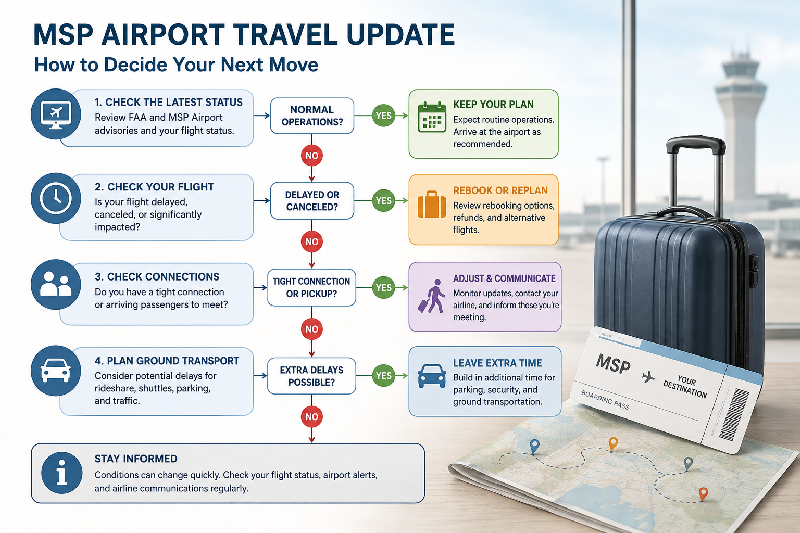
If you are flying through MSP Airport after the recent FAA equipment outage, the most important question is no longer simply, “What happened?” The practical question is whether the disruption could still affect your flight, connection, airport arrival time, or transportation plans.
On August 6, 2026, Minneapolis–Saint Paul International Airport experienced a temporary ground stop connected to a regional Federal Aviation Administration equipment problem. Departures began moving again after the restriction was lifted. By August 7, MSP’s official flight information showed many scheduled flights operating normally, and the FAA’s current national status information did not indicate that the previous MSP ground stop was still in effect.
That is encouraging, but a lifted ground stop does not instantly reset an airport. Aircraft, crews, gates, and connecting passengers can all end up in the wrong places after a disruption. Travelers using MSP should therefore continue checking their individual flights rather than assuming every schedule has returned to normal.
What Happened at MSP Airport?
The August 6 disruption was tied to an FAA equipment outage affecting regional air traffic operations. MSP temporarily stopped certain departures while the problem was addressed. Once the equipment issue was resolved, flights gradually resumed.
A ground stop is an air traffic management measure. It generally keeps affected aircraft on the ground instead of allowing more planes to enter already constrained airspace. It can be inconvenient, but it is designed to manage traffic safely while an operational problem is being resolved.
The key point for travelers is that the original restriction has ended. The bigger concern now is the ripple effect. A flight scheduled several hours after an outage can still be delayed if its aircraft arrived late, a crew exceeded working limits, or a gate remained occupied longer than planned.
Is MSP Airport Back to Normal?
Conditions appear substantially improved compared with the August 6 disruption. MSP’s official flight board on August 7 showed many departures and arrivals listed as on time. The FAA’s National Airspace System status page should remain one of the best places to check for any renewed airport-wide restrictions.
However, “airport operating normally” and “your flight is on time” are not the same thing. Airlines recover at different speeds, and one route may be disrupted while another operates exactly as scheduled.
| What you see | What it means for you | What to do |
|---|---|---|
| Flight shown on time | No known major schedule change yet | Travel to the airport normally and keep notifications on |
| Delay under an hour | Could be part of normal operations or outage recovery | Stay with the original airport arrival plan unless the airline says otherwise |
| Repeated delay changes | The airline may still be repositioning an aircraft or crew | Check where your incoming aircraft is coming from and watch the airline app |
| Flight cancelled | You will likely need rebooking or may qualify for a refund | Use the airline app immediately before joining a customer-service line |
| FAA announces another ground stop | Airport-wide delays could increase again | Check both your airline and FAA status before leaving for MSP |
Should You Arrive at MSP Earlier Than Usual?
You generally do not need to arrive several extra hours early solely because of yesterday’s FAA outage if your flight is operating normally. Arriving excessively early will not protect you from an air traffic delay.
Instead, use your normal airport buffer while adding enough flexibility to handle security, parking, baggage, and terminal navigation. If your airline recommends a particular arrival time, follow that guidance.
Do not intentionally arrive late because your flight shows a delay. Airlines sometimes shorten delays when aircraft or crews become available sooner than expected, and check-in and checked-bag deadlines usually remain important.
Before leaving home, check three things: your airline app, the MSP flight-status page, and current FAA airport restrictions. Those checks are more useful than relying on an old social media post about the ground stop.
Connecting Through MSP? Give Yourself More Flexibility
Connecting passengers have more exposure to residual delays because even a relatively small schedule change can eliminate the time available between flights.
For example, suppose you have a 55-minute connection at MSP. A 30-minute delay on your first flight leaves very little margin for taxiing, getting off the aircraft, and reaching another concourse. A traveler whose final destination has only one or two flights per day faces more risk than someone traveling to a city with frequent service.
If you have not traveled yet and can choose between similar itineraries, a longer connection may be worthwhile during a recovery period. This is especially true for international itineraries, families traveling with children, passengers who need mobility assistance, and anyone connecting to the final flight of the evening.
If you are already traveling and your connection looks doubtful, open your airline’s app before landing. Some airlines automatically offer alternative flights once their system predicts that a connection will be missed.
What to Do If Your MSP Flight Is Delayed
First, determine whether the aircraft is actually at MSP. A departure can remain delayed because the incoming aircraft has not arrived. Your airline’s app may show the previous flight associated with your aircraft.
Next, look at alternative flights before speaking with an agent. If you can tell the airline representative, “There are seats on the 6:20 p.m. flight through Chicago,” the conversation may move faster than simply asking what options exist.
Also avoid cancelling your reservation yourself until you understand what the airline is offering. Voluntarily cancelling a ticket can produce a different outcome from having the airline cancel or significantly change the flight.
When Can You Get a Refund?
U.S. Department of Transportation rules provide important protection when an airline cancels or significantly changes a flight. If the airline cancels your flight and you decide not to travel or accept the alternative transportation offered, you are generally entitled to a refund.
Refund rights can also apply when a flight is significantly delayed or changed and you decline the changed itinerary. DOT rules define several types of significant changes, including sufficiently large schedule changes and certain changes to airports, connections, or accessibility arrangements.
This is different from reimbursement for meals or hotels. Those benefits can depend on why the disruption occurred and on the airline’s customer-service commitments. A problem caused by an FAA system is not necessarily considered an airline-controlled disruption, so travelers should not assume that a hotel or meal voucher is automatically owed.
If you still want to reach your destination, rebooking may be more valuable than requesting a refund. Once you choose a refund and abandon the itinerary, buying a replacement ticket at the last minute could be expensive.
Know Which MSP Terminal You Need
MSP has two passenger terminals, and going to the wrong one can waste valuable time.
Terminal 1 serves most of MSP’s commercial airlines, including Delta, American, United, Air Canada, Air France, KLM, Lufthansa, and several others. Terminal 2 serves a smaller group of carriers. Because airline assignments can change, confirm your terminal through MSP or your airline before leaving for the airport.
If you do end up at the wrong terminal, the situation is fixable. MSP provides free light-rail transportation between Terminal 1 and Terminal 2. Trains operate between the terminals around the clock and generally run about every 15 minutes.
Still, changing terminals adds walking and waiting time, so checking before your trip is much easier.
Parking and Ground Transportation During Disruption Recovery
A flight delay can also change your ground-transportation decisions. Someone dropping you off may prefer to wait until your flight status stabilizes rather than circling the airport unnecessarily.
If you are parking, MSP allows travelers to reserve airport parking in advance. The airport says advance parking reservations can guarantee a space and may offer lower online pricing than arriving without a reservation.
For travelers using Uber, Lyft, or similar services, pickup locations differ by terminal. Terminal 1 app-based rides use the Ground Transportation Center on Level 1 of the Green and Gold parking ramps. At Terminal 2, app-based pickup is on the second level of the Purple Ramp.
Public transportation is another useful option. Light rail connects MSP with Minneapolis and the Mall of America area and also provides free transportation between the two airport terminals.
A Simple MSP Airport Plan for Travel Day
- Check your flight before leaving home. Use the airline app rather than relying only on yesterday’s outage reports.
- Check FAA conditions. Look for a new ground stop, ground-delay program, or other restriction involving MSP.
- Confirm your terminal. Terminal 1 and Terminal 2 have separate road access and parking areas.
- Keep your normal airport arrival buffer. Do not arrive late merely because the departure time has been pushed back.
- Watch your connection. If your first flight slips, research backup flights before you reach MSP.
- Keep receipts during major disruptions. They may be useful for an airline claim or travel-insurance request, even when reimbursement is not guaranteed.
Should You Change an Upcoming Trip Through MSP?
For most travelers, the August 6 equipment outage alone is not a strong reason to avoid MSP or pay to change an upcoming trip. The ground stop was temporary, flights resumed, and current airport information indicates broad operations have continued.
Changing plans may make more sense if your individual flight remains disrupted, you have an unusually short connection, or missing your final flight would create a major problem such as losing a cruise departure, international connection, wedding, or prepaid tour.
When comparing alternatives, consider the entire trip rather than just the first flight. A nonstop flight departing slightly later can sometimes be safer than an earlier itinerary requiring a tight connection.
Frequently Asked Questions About MSP Airport
Is MSP Airport currently closed?
No. The August 6 FAA-related ground stop was temporary, and flights subsequently resumed. Travelers should still check current FAA and airline information because airport conditions can change.
Will yesterday’s FAA outage delay my flight today?
Possibly, but not necessarily. Many flights may operate normally while individual aircraft or crews remain affected by earlier delays. Check your specific flight rather than assuming the entire airport is delayed.
Should I go to MSP if my flight is delayed?
Usually yes, unless your airline specifically instructs you otherwise. Airlines can revise departure times, and normal bag-check and boarding deadlines can still apply.
Can I get money back if my flight is cancelled?
If the airline cancels your flight and you choose not to travel or accept the alternative offered, DOT rules generally require a refund. Rebooking, hotel, meal, and other benefits depend on the circumstances and airline policies.
How do I move between MSP Terminal 1 and Terminal 2?
The airport’s light-rail service connects the terminals free of charge. Service operates around the clock, with trains generally arriving approximately every 15 minutes.
Bottom Line
The FAA equipment outage at MSP Airport caused a real disruption, but travelers should focus on current conditions rather than the original ground stop. The restriction was lifted, operations resumed, and many August 7 flights were showing normal schedules.
The safest strategy is simple: check your airline before leaving, review the FAA’s current airport status, confirm your MSP terminal, and leave extra flexibility if you have a tight connection. If a cancellation or major delay does occur, compare rebooking options before accepting a voucher or abandoning your trip, and understand your federal refund rights.
For travelers with flights later in the week, there is no clear reason based solely on this temporary outage to avoid Minneapolis–Saint Paul International Airport. Your individual flight status and connection schedule matter much more than yesterday’s headline.
References
- MSP Airport — Flight Information — Official arrivals and departures page used to check current flight status, airlines, terminals, and whether individual flights are operating normally.
- Federal Aviation Administration — National Airspace System Status — Official FAA resource for active ground stops, delay programs, airport closures, and other air traffic restrictions.
- MSP Airport — Ground Transportation — Supports information about light rail between terminals, taxis, shuttles, rental cars, and other airport transportation options.
- MSP Airport — Parking — Official information about airport parking choices, advance reservations, and parking availability.
- U.S. Department of Transportation — Airline Refunds — Explains passenger refund rights following cancelled or significantly changed flights.
- U.S. Department of Transportation — Airline Cancellation and Delay Dashboard — Shows airline commitments involving rebooking, meals, hotels, and other assistance during qualifying controllable disruptions.