
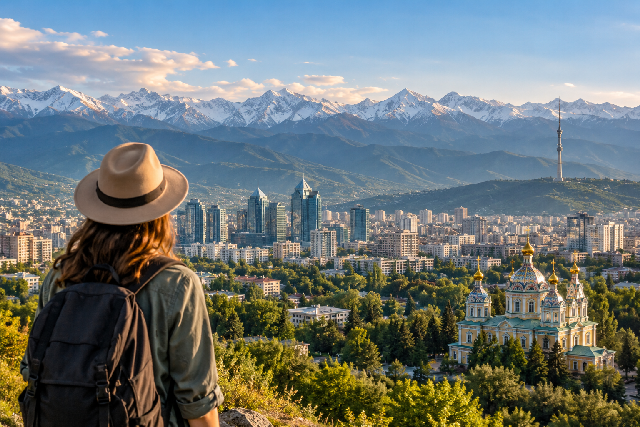
Kazakhstan is suddenly getting more attention from American searchers. Recent headlines have highlighted archaeological work at a former Soviet Gulag site, new international energy and mineral agreements, and the country’s effort to expand its role in global trade. For travelers, however, the more useful question is simple: What is it actually like to plan a trip to Kazakhstan from the United States?
Kazakhstan is the world’s largest landlocked country, and its enormous size matters when planning an itinerary. A trip can combine the modern cities of Almaty and Astana with mountains, canyons, steppe landscapes, historical sites, and traces of the Soviet era. But distances are large, nonstop options from the United States are limited, and transportation choices can have a major effect on how much time you spend sightseeing rather than traveling.
Here is what U.S. travelers should check before booking a Kazakhstan trip in 2026.
Why Kazakhstan Is Getting More Attention
Kazakhstan has appeared in several international news stories in September 2026. Archaeologists have been examining the remains of the Soviet-era Steplag prison camp near Zhezkazgan. Separately, Kazakhstan and South Korea signed agreements involving peaceful nuclear energy, crude oil, technology, and critical minerals. The country has also been promoting greater trade and investment beyond its traditional commodity exports.
These stories do not mean that tourists need to change their plans. Instead, they help explain why a country that may have received relatively little attention from many Americans is appearing more frequently in international coverage.
For travelers interested in Central Asia, Kazakhstan can also work as a starting point for understanding the region. Almaty offers restaurants, museums, parks, and easy access to mountain scenery, while Astana presents a very different experience built around modern architecture and its role as the national capital.
Can Americans Visit Kazakhstan Without a Visa?
For ordinary short vacations, entry is relatively straightforward. Kazakhstan’s government lists U.S. citizens among nationalities eligible for visa-free entry for stays of up to 30 calendar days. The government’s published rules also specify a cumulative limit of 90 days within a 180-day period.
Travelers planning a longer stay or a purpose that does not qualify under the visa-free rules should check the appropriate visa requirements before buying nonrefundable tickets.
Passport rules should also be verified shortly before departure. Entry requirements can change, and airline staff may check documentation before allowing passengers to board.
There is another detail worth knowing if you stay in a private apartment or other nontraditional accommodation. Kazakhstan requires the host or accommodation provider to notify migration authorities of a foreign visitor’s arrival within three working days. Hotels normally handle their own guest procedures. If you rent an apartment or stay with someone, ask the host to confirm that the required arrival notification will be completed.
Getting to Kazakhstan From the United States
The flight is likely to be one of the biggest planning challenges for an American visitor. Kazakhstan is far from the United States, and most U.S. itineraries require at least one connection.
Depending on your departure city and travel dates, useful connecting points may include major hubs in Europe, the Middle East, or Asia. Air Astana, Kazakhstan’s flag carrier, serves destinations across Europe, Asia, Central Asia, and the Middle East, providing several possible ways to connect onward to Almaty or Astana.
| Planning question | What U.S. travelers should consider |
|---|---|
| Where should I arrive? | Almaty often makes sense for mountains and southeastern Kazakhstan; Astana works well for the capital and northern areas. |
| Should I book one ticket? | A single through-ticket can provide better protection when a delay causes a missed connection. |
| Is a long layover bad? | Not necessarily. Extra connection time can reduce stress on a complicated international itinerary. |
| Should I fly between Kazakh cities? | Often yes when distances are long and vacation time is limited. |
Compare the entire itinerary rather than simply choosing the cheapest fare. A ticket that saves $100 but adds an overnight connection or a self-transfer between airlines may not be the better deal.
Also check transit requirements for the country where you connect. Those rules are separate from Kazakhstan’s entry requirements.
Almaty or Astana: Where Should You Start?
For many first-time visitors, Almaty is the easier place to build a leisure-focused itinerary. Kazakhstan’s largest city sits near the mountains and provides access to outdoor destinations in the southeast. It also offers a large selection of hotels, restaurants, museums, cafés, and city attractions.
Astana is the national capital and provides a striking contrast. It is known for contemporary architecture, broad avenues, government institutions, cultural attractions, and a dramatically different climate.
Travelers with enough time can visit both. But do not treat them as neighboring cities. Kazakhstan’s scale makes transportation planning important, and flying can be much more practical than sacrificing a large portion of a short vacation to an overland journey.
Domestic Flights and Trains Can Both Be Useful
Domestic aviation is especially useful when your itinerary includes distant regions. Kazakhstan has an extensive domestic flight network, including services operated by Air Astana and FlyArystan.
Rail is another option. Kazakhstan’s passenger railway network connects major cities and can be useful for travelers who want to see more of the country at ground level. Overnight trains may also replace a hotel night on certain routes.
The right choice depends on the trip. If you have seven or eight days, flights can preserve valuable sightseeing time. With two or three weeks, trains become easier to incorporate without making the itinerary feel rushed.
Getting Around After You Arrive
Within major cities, rideshare apps can be one of the simplest transportation options for visitors. The U.S. State Department advises travelers to avoid unmarked taxis and to be selective about taxi services. It also notes that ridesharing apps are widely available.
That is particularly useful when arriving at an airport. Rather than accepting an unsolicited ride from someone in the arrivals area, use an official taxi arrangement, a reputable rideshare service, or transportation organized by your hotel.
For excursions outside cities, transportation requires more preparation. Attractions may be separated by long stretches of road, and conditions can vary. A guided day trip or reputable driver may make more sense than renting a car for travelers unfamiliar with local roads.

Money, Cards, and Paying for Your Trip
Kazakhstan’s currency is the Kazakhstani tenge (KZT). U.S. dollars are not the everyday payment currency, so travelers should expect purchases to be priced in tenge.
The State Department reports that most establishments accept credit cards, although a PIN may sometimes be required. ATMs accepting U.S.-issued bank cards are also available.
Before leaving the United States, check whether your credit card charges a foreign transaction fee. A card with no foreign transaction fee can simplify purchases, but carrying some local cash is still sensible for small vendors, markets, tips, or situations where card processing is unavailable.
When a terminal offers to convert a purchase into U.S. dollars, pay attention to the exchange rate being offered. Paying in local currency often allows your card network to perform the conversion instead of accepting a merchant’s separate currency-conversion offer.
What About Safety?
As of August 18, 2026, the U.S. Department of State lists Kazakhstan at Level 1: Exercise Normal Precautions, its lowest travel-advisory level. The department describes Kazakhstan as generally safe for travelers.
Normal precautions still matter. The State Department identifies pickpocketing, purse snatching, robbery, and assault among crimes travelers could encounter. Visitors should protect phones and wallets in crowded places and avoid poorly identified transportation.
Demonstrations can also occur. Travelers should avoid protests and monitor local information if demonstrations affect roads or public areas.
Weather deserves attention as well. Kazakhstan experiences flooding, and the country’s continental climate can produce substantial seasonal differences. Conditions in Astana can be very different from those an American traveler might imagine when thinking about a general “Central Asia” trip.
When Is the Best Time to Visit Kazakhstan?
There is no single ideal month because Kazakhstan is enormous and travelers come for different reasons. Spring and fall can be attractive for urban sightseeing because they avoid some temperature extremes. Summer can work well for mountain trips, hiking, and longer daylight hours, although popular outdoor areas may be busier.
Winter changes the experience completely. Travelers interested in snow and winter scenery may enjoy it, but Astana is known for severe cold. Anyone planning extensive outdoor sightseeing should look at historical temperatures for the exact cities and regions on the itinerary rather than relying on a nationwide forecast.
A Practical First-Trip Itinerary
For a first visit of roughly one week, trying to see the entire country is unrealistic. A more comfortable approach is to choose one main region.
A traveler primarily interested in scenery could spend several days in Almaty, then use organized excursions or private transportation to explore nearby natural attractions. Someone interested in modern architecture, museums, and the country’s political center could add Astana by domestic flight.
With 10 to 14 days, combining Almaty and Astana becomes more reasonable. Additional destinations can then be selected based on interests rather than simply adding stops because they look close on a map.
This is one destination where fewer bases can produce a better trip. Kazakhstan’s size makes an overly ambitious itinerary expensive and tiring.
What to Check Before You Book
- Confirm current passport and visa-free entry requirements using official government sources.
- Check the latest U.S. State Department travel advisory.
- Compare flights into both Almaty and Astana before deciding on an itinerary.
- Check transit-country requirements for every international connection.
- Ask private accommodation hosts about Kazakhstan’s foreign-visitor notification requirement.
- Compare domestic flights with train schedules before locking in hotels.
- Check seasonal temperatures for each region you plan to visit.
- Use a payment card that does not add unnecessary foreign transaction fees when possible.
- Keep some tenge available for smaller purchases.
- Consider enrolling in the State Department’s Smart Traveler Enrollment Program before departure.
Frequently Asked Questions About Kazakhstan Travel
Do U.S. citizens need a visa for Kazakhstan?
For qualifying short visits, U.S. citizens can enter Kazakhstan visa-free for up to 30 calendar days under the country’s current published rules. Longer stays or different travel purposes may require a visa. Verify the rules before departure because immigration requirements can change.
Is Kazakhstan currently safe for American tourists?
The U.S. State Department’s advisory issued August 18, 2026 places Kazakhstan at Level 1, meaning travelers should exercise normal precautions. Visitors should still follow ordinary precautions involving valuables, transportation, demonstrations, and weather.
Should first-time visitors choose Almaty or Astana?
Almaty is a strong starting point for travelers who want a combination of city experiences and nearby mountain scenery. Astana is particularly interesting for modern architecture, museums, and seeing Kazakhstan’s capital. Travelers with enough time can visit both.
Can I use U.S. credit cards in Kazakhstan?
Cards are accepted at many establishments, according to the State Department, and ATMs accepting U.S.-issued bank cards are available. Carrying some local currency remains useful, especially outside major commercial areas.
Has the recent Kazakhstan news made travel more difficult?
The September 2026 stories driving international attention largely concern archaeology, trade, energy, minerals, and international cooperation. They do not by themselves indicate a new nationwide tourism restriction. Travelers should base safety decisions on current government advisories and check airline schedules and entry rules close to departure.
Bottom Line
Kazakhstan can be a rewarding destination for Americans looking beyond the most familiar European and Asian vacation routes. The biggest planning issue is not necessarily entry paperwork. It is geography. Distances are enormous, international journeys can require connections, and an itinerary that looks reasonable on a map may consume too much vacation time in transit.
Start by deciding whether Almaty, Astana, or both best match your interests. Then build transportation around those choices rather than collecting destinations first. Check entry rules, flight schedules, accommodation notification requirements, weather, and the latest travel advisory again shortly before departure. With those basics handled, Kazakhstan becomes much easier to approach as a practical vacation rather than simply an intriguing place appearing in the news.
References
- U.S. Department of State — Kazakhstan Travel Advisory and Travel Guidance — Supports current safety-advisory information, transportation precautions, payment guidance, emergency information, and travel preparation recommendations.
- Consulate General of Kazakhstan — Visa-Free Regime — Supports the visa-free entry information for U.S. citizens and the published short-stay limit.
- Government of Kazakhstan — Notification of Foreign Citizen Arrival — Explains the host or accommodation provider’s responsibility to notify migration authorities after a foreign visitor arrives or changes accommodation.
- Air Astana — Destinations — Supports information about international and regional air connections available through Kazakhstan’s flag carrier.
- Kazakhstan Temir Zholy Passenger Ticket Service — Official passenger railway resource for checking train routes, schedules, and tickets within Kazakhstan.