
Traveling through LaGuardia Airport can be convenient, especially for trips between New York City and major U.S. destinations. However, weather delays and possible airline terminal changes can quickly complicate an otherwise simple trip.
Recent storms and flood concerns across the New York area have drawn attention to delays and cancellations at LGA Airport. At the same time, JetBlue has secured additional LaGuardia takeoff and landing rights and is considering a future move from Terminal B to Terminal A, also known as the Marine Air Terminal.
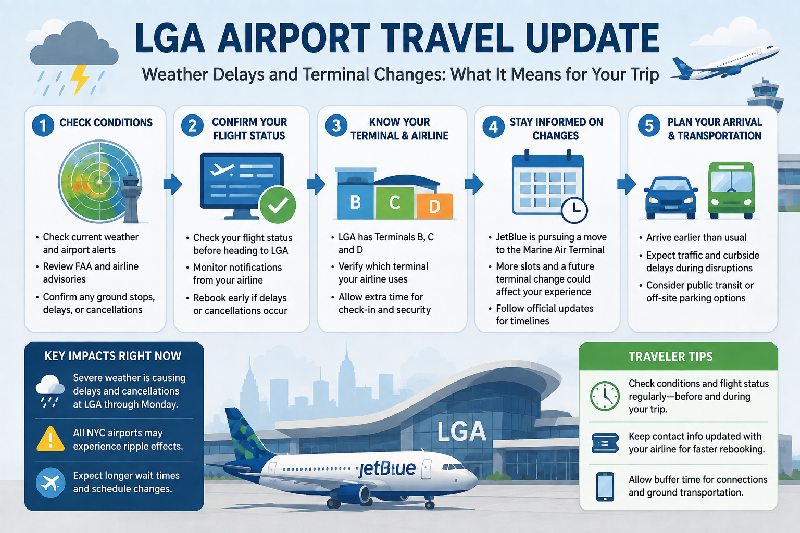
These developments do not mean every traveler needs to change a reservation. They do mean that passengers should check their flight status, confirm their terminal, and build extra flexibility into their plans. Here is what travelers need to know before heading to LGA.
What Is Happening at LGA Airport?
Two separate issues are affecting travel planning at LaGuardia:
- Weather disruptions: Storms, heavy rain, low visibility, and flood risks can reduce the number of flights the airport can safely handle.
- Future airline changes: JetBlue has acquired additional flight slots previously controlled by Spirit Airlines and has expressed interest in returning to the Marine Air Terminal.
The weather issue can affect travelers immediately. The JetBlue terminal proposal is a longer-term development and should not be treated as an immediate relocation.
As of the morning of August 3, 2026, the Federal Aviation Administration’s airport status page showed LGA operating without major airport-wide delays, although light rain and mist were reported. Conditions can change during the day, so this status should be viewed as a snapshot rather than a guarantee.
Why Weather Causes Major Delays at LaGuardia
LaGuardia operates in one of the busiest areas of U.S. airspace. Flights arriving at or departing from LGA share the region with traffic from John F. Kennedy International Airport, Newark Liberty International Airport, and several smaller airports.
During thunderstorms or heavy rain, air traffic controllers may need to create more space between aircraft. Runway capacity can fall, and flight routes around storm cells may become crowded. A problem near one New York airport can also affect the others.
The FAA may respond with several types of restrictions:
| FAA action | What it means | What travelers may experience |
|---|---|---|
| Ground stop | Flights headed to LGA may be held at their departure airports. | Your plane may board late or remain at the gate even when the weather looks clear locally. |
| Ground delay program | Arrivals are assigned controlled departure times to reduce congestion. | Your flight may show a delay before leaving its origin. |
| Taxi delay | Aircraft wait longer before takeoff or after landing. | You may sit on the plane even though the flight appears to have departed or arrived. |
| Rerouting | Flights are sent around storms or restricted airspace. | Flight time may increase, and missed connections become more likely. |
One important point is that sunny weather at your departure airport does not protect you from a LaGuardia delay. Your flight may be held because of weather over New York, congestion along the route, or restrictions affecting the wider Northeast.
How to Check Whether Your LGA Flight Is Affected
Do not rely on a single source. Airport conditions, airline schedules, and individual flight status can show different information.
Use this order:
- Check the airline app first. This is usually the best source for your exact aircraft, gate, boarding time, cancellation status, and rebooking options.
- Check the official LGA flight page. It lists current arrivals, departures, gate changes, delays, and cancellations.
- Review the FAA airport status. This helps you see whether LGA is facing an airport-wide delay, ground stop, or air traffic restriction.
- Check the weather along the route. Storms between your origin and New York can matter even when conditions at LGA are improving.
Check once the night before, again before leaving home, and once more while traveling to the airport. During severe weather, a flight that appears on time in the morning can still be delayed later.
Should You Arrive Earlier During Bad Weather?
Arriving earlier will not make a delayed plane depart sooner, but it can protect you from other problems. Road traffic may worsen in heavy rain, airport shuttles can slow down, and check-in lines may grow when many passengers are being rebooked.
For a domestic flight, many travelers normally aim to enter the terminal about two hours before departure. During storms, holidays, or peak travel periods, adding another 30 to 60 minutes can be sensible.
Extra time is especially useful when:
- You are checking luggage.
- You are traveling with children or someone who needs assistance.
- You have not completed online check-in.
- Your airline has already warned of possible disruption.
- You are unfamiliar with your terminal.
Do not arrive extremely early without checking airline counter hours. Some baggage counters may not accept luggage many hours before departure.
What the JetBlue Terminal News Means
JetBlue won an auction in July 2026 for takeoff and landing slots formerly held by Spirit Airlines at LaGuardia. Court documents reported a purchase price of $58.5 million. These slots could allow JetBlue to operate up to roughly 12 additional daily round trips, subject to required approvals and final scheduling decisions.
JetBlue has also indicated interest in moving its LaGuardia operation from Terminal B to Terminal A, the historic Marine Air Terminal. The airline previously operated there before consolidating its flights in Terminal B in 2022.
For travelers, the most important fact is that this is not an immediate terminal switch. Reports indicate that the additional flights are not expected to begin before 2027. Regulatory approval, airport arrangements, renovations, and operating plans may still affect the timing.
Passengers flying JetBlue now should continue to follow the terminal listed in their reservation and airline app. Do not go to Terminal A simply because of the recent news.
Why a Terminal Change Would Matter
Terminal B is a large, modern facility used by several airlines. Terminal A is much smaller and is located separately from the main terminal complex.
If JetBlue eventually moves, travelers could notice changes in several areas:
- Drop-off location: A driver following signs for Terminal B could leave a passenger at the wrong part of the airport.
- Public transportation: Bus routes and transfer steps may differ depending on the terminal.
- Food and services: A smaller terminal may have fewer dining, shopping, and lounge choices.
- Security lines: A dedicated terminal could feel simpler, but wait times would depend on staffing and flight schedules.
- Connections between airlines: Travelers changing from JetBlue to another carrier could face a terminal transfer and another security screening.
The possible move could make JetBlue’s operation more self-contained. However, it may be less convenient for passengers connecting to airlines based in Terminal B or Terminal C.
Confirm Your Terminal Before Every LGA Trip
LaGuardia currently has Terminal A, Terminal B, and Terminal C. Airlines can move gates, and long-term terminal assignments can change.
Never choose your taxi, rideshare drop-off, or parking area using an old trip as your guide. Confirm the terminal for the current flight.
| Before leaving home | What to confirm |
|---|---|
| Airline reservation | Airport code is LGA, not JFK or EWR |
| Airline app | Terminal, gate, boarding time, and delay status |
| Airport website | Any last-minute terminal or gate update |
| Transportation booking | Correct terminal entered as the destination |
New York has three major airports, and booking mistakes do happen. Double-check that your reservation says LGA before arranging transportation.
Ground Transportation During Storms
Weather can disrupt more than flights. Heavy rain may slow traffic on the Grand Central Parkway and nearby streets. Rideshare prices may rise as demand increases, and pickup areas can become crowded after multiple delayed flights land at once.
Travelers have several common transportation choices:
- Taxi or rideshare: Convenient for door-to-door travel, but prices and travel times can increase during storms.
- Q70 LaGuardia Link bus: Connects the airport with subway and Long Island Rail Road service in Queens.
- M60 bus: Useful for parts of Manhattan and Queens, depending on your destination.
- Private shuttle or car service: Can offer more certainty for groups, but may cost more.
Allow extra road time when rain is heavy. For an important appointment, cruise departure, wedding, or international connection, consider traveling earlier than usual or staying near the airport the night before.
What to Do If Your Flight Is Delayed or Canceled
Act quickly, especially when many flights are affected.
- Open the airline app and look for automatic rebooking options.
- Search for alternate flights before joining a customer service line.
- Consider nearby airports only after comparing transportation time and cost.
- Keep receipts for meals, hotels, and ground transportation.
- Review the airline’s policy and any travel insurance or credit card protection.
Airlines generally have more responsibility when a cancellation is within their control, such as certain staffing or maintenance problems. Weather-related expenses are less likely to be covered. Policies vary, so ask what the airline will provide instead of assuming that a hotel or meal voucher is included.
If the airline cancels your flight and you decide not to travel, you may generally request a refund for the unused portion rather than accepting a future credit. Review the current U.S. Department of Transportation refund guidance for your situation.
Should You Change Your LGA Booking?
Most travelers do not need to avoid LaGuardia because of one period of bad weather or a possible future terminal move.
Keeping your booking usually makes sense when your flight is nonstop, the schedule has not changed, and you have some flexibility. Consider alternatives when missing the trip would cause a major financial loss or when the forecast shows a high risk of severe storms during a short connection.
Morning flights can sometimes offer an advantage because delays may build as the day continues. This is not guaranteed, but an early nonstop flight often provides more recovery options if something goes wrong.
Frequently Asked Questions
Is LGA Airport currently closed?
No airport-wide closure was reported on the FAA status page on the morning of August 3, 2026. Conditions can change quickly, so check the FAA and your airline before departure.
Are all LaGuardia flights delayed when storms reach New York?
No. Some flights may depart normally while others are delayed or canceled. The effect depends on the airline, route, aircraft position, crew availability, and air traffic restrictions.
Has JetBlue already moved to Terminal A?
No. JetBlue currently directs its LaGuardia passengers according to the terminal shown in their reservations, generally Terminal B at the time of this update. The proposed Terminal A move is a future plan, not an immediate change.
When could JetBlue add its new LGA flights?
Reports indicate that the additional slot-based service is not expected before 2027. The final routes, schedules, approvals, and terminal arrangements have not all been completed.
Can I walk between every LaGuardia terminal?
Travelers should not assume that every terminal transfer is a simple indoor walk. Follow airport signs and official transportation instructions. Changing terminals may take additional time and could require another security screening.
How much extra time should I allow during severe weather?
Adding 30 to 60 minutes to your normal airport arrival plan is reasonable for many travelers. Allow more time when roads are flooding, you are checking bags, or you have a high-stakes connection.
Bottom Line
The current LGA airport story involves both a short-term weather concern and a longer-term airline development. Storms can cause sudden delays, cancellations, and ground restrictions across the New York airport system. JetBlue’s newly acquired slots and possible move to the Marine Air Terminal could eventually change where some passengers check in, but the shift is not happening immediately.
For your next trip, focus on what you can control. Check the airline app, verify your terminal, watch the FAA status, allow extra travel time, and understand your rebooking options. These simple steps can prevent a weather delay or terminal surprise from turning into a much larger travel problem.
References
- LaGuardia Airport Flight Information — Official Port Authority page for real-time arrivals, departures, delays, cancellations, gates, and terminals.
- FAA LaGuardia Airport Status — Supports current airport-wide delay and weather status information.
- FAA National Airspace System Status — Explains active ground stops, ground delay programs, and other national air traffic restrictions.
- Port Authority: New LGA Terminal B — Supports information about Terminal B facilities and LaGuardia’s redevelopment.
- U.S. Department of Transportation Airline Cancellation and Delay Dashboard — Supports passenger guidance on airline commitments during controllable disruptions.
- U.S. Department of Transportation Refund Guidance — Explains refund rights when an airline cancels or significantly changes a flight.