
Airport security rules can feel simple until one small item creates a problem. A jar of food, a portable charger, or an unfamiliar airport program can change how long you spend at security and whether an item makes it onto the plane.
In 2026, several TSA-related topics are getting extra attention. Travelers are asking more questions about what food can go through checkpoints, where portable chargers belong, and how a new program called Gateside by TSA PreCheck works at selected airports.
The important point is that these are not all one nationwide rule change. Some are long-standing TSA or FAA requirements getting renewed attention. Others, such as Gateside by TSA PreCheck, are newer programs available only at participating airports.
Here is what travelers should know before packing or heading to the airport.
What Has Changed for Travelers in 2026?
The biggest practical change is not that TSA suddenly banned everyday food or ordinary phone chargers. Instead, travelers are facing more reminders about how existing rules are applied, especially when an item is liquid-like, contains a lithium battery, or requires additional screening.
At the same time, TSA has begun expanding Gateside by TSA PreCheck, a program that allows some approved people without airline tickets to pass through security at participating airports.
| Topic | What Travelers Should Know |
|---|---|
| Solid food | Generally allowed in both carry-on and checked baggage, but officers may ask travelers to separate food during screening. |
| Liquid or gel food | Usually subject to TSA’s carry-on liquid limits unless an exemption applies. |
| Portable chargers | Power banks containing lithium batteries belong in carry-on baggage, not checked luggage. |
| Large batteries | Batteries above certain watt-hour limits may require airline approval or may not be allowed. |
| Gateside by TSA PreCheck | Allows eligible approved visitors without boarding passes to enter secure airport areas at selected airports. |
TSA Food Rules: What Can You Bring Through Security?
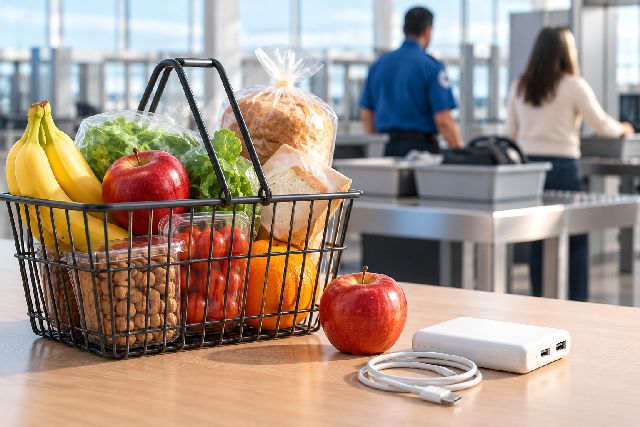
Most solid foods can travel through a TSA checkpoint. Examples can include sandwiches, cookies, candy, bread, fruit, pizza and other foods that are clearly solid.
TSA states that solid food can generally be packed in either carry-on or checked bags. The situation becomes more complicated when food behaves more like a liquid or gel.
For example, a solid chocolate bar is very different from a jar of chocolate spread. A sandwich is different from a container of soup. Large quantities of sauces, dips, spreads or similar foods may fall under TSA’s liquid restrictions when placed in a carry-on.
The 3.4-Ounce Rule Still Matters
For ordinary carry-on liquids, gels, aerosols, creams and pastes, containers generally must be 3.4 ounces, or 100 milliliters, or less and fit within the passenger’s permitted liquids bag.
That can apply to some foods too. If you are unsure whether TSA would treat something as a solid or a liquid, consider its consistency. Foods that pour, spread, spray or take the shape of their container are more likely to receive liquid-style treatment.
If you are bringing a larger quantity and do not need it during the flight, checked baggage may be easier.
Why Permitted Food Can Still Slow You Down
An item can be legal to carry and still trigger extra screening.
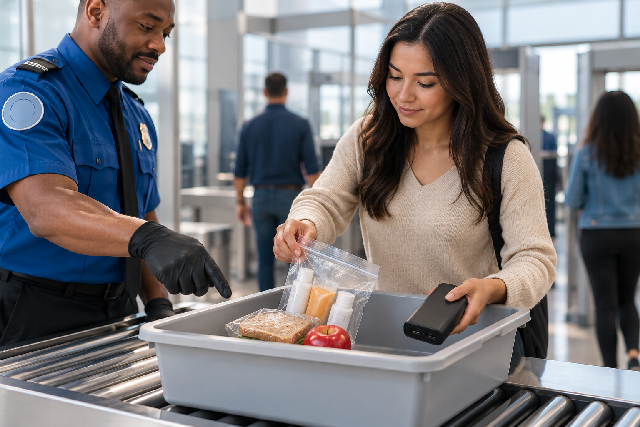
TSA notes that officers may ask passengers to separate foods, powders or other dense items because they can make X-ray images harder to interpret. That means a bag packed tightly with snacks, electronics and food containers may take longer to inspect than a simple carry-on.
For travel planning, the lesson is simple: do not bury unusual or dense food items at the bottom of your bag. Keep them accessible so you can remove them quickly if an officer asks.
Portable Charger Rules: Carry-On Yes, Checked Bag No
Portable chargers are one of the most common items travelers misunderstand.
A typical power bank contains a rechargeable lithium-ion battery. Under current federal aviation rules, spare lithium batteries and power banks must be carried in the cabin rather than inside checked baggage.
That includes many phone charging banks, external laptop batteries and rechargeable battery packs.
If an airline employee asks you to gate-check your carry-on because the overhead bins are full, remove your power bank before handing over the bag. Keep the charger with you in the cabin.
Battery Size Matters
The Federal Aviation Administration uses watt-hours, commonly written as Wh, to classify rechargeable lithium batteries.
- Up to 100 Wh: generally allowed for personal use in carry-on baggage.
- More than 100 Wh and up to 160 Wh: may be allowed with airline approval, typically with limits on larger spare batteries.
- More than 160 Wh: generally prohibited on passenger aircraft, except for certain specially regulated equipment such as qualifying mobility devices.
Most ordinary smartphone power banks fall below 100 Wh, but travelers should still check the printed specifications on larger battery packs.
The FAA also warns that airlines may impose stricter limits than the basic federal allowance. This matters particularly on international trips, where an airline may restrict the number, capacity or use of portable chargers.
Do Airlines Have Their Own Portable Charger Rules?
Yes. TSA controls security screening, but aviation battery rules also involve the FAA, and airlines can have their own additional restrictions.
For example, one airline may permit a standard power bank but prohibit passengers from using or charging it during the flight. Another may limit the number of batteries you can carry.
Before an international flight or before traveling with a high-capacity charger, check your airline’s dangerous-goods or battery policy.
This is especially important if your power bank has no visible watt-hour rating. Airport staff may have difficulty confirming whether it falls within allowed limits.
A Simple Packing Strategy for Food and Chargers
You can reduce airport delays by separating items into three groups before leaving home.
| Item Type | Best Place to Pack It | Why |
|---|---|---|
| Solid snacks | Carry-on or checked bag | Usually permitted, but keep carry-on food accessible for screening. |
| Large liquid or gel foods | Checked bag when permitted | Avoids carry-on liquid limits. |
| Small travel-size liquid foods | Carry-on liquids bag | Must generally fit TSA liquid requirements. |
| Portable charger | Carry-on only | Lithium power banks cannot be placed in checked baggage. |
| Large battery pack | Check airline policy first | Higher-capacity batteries may need approval. |
If you are carrying something unusual, check TSA’s searchable “What Can I Bring?” database before leaving for the airport.
What Is Gateside by TSA PreCheck?
Gateside by TSA PreCheck is a newer program that brings back something many travelers remember from years ago: meeting or saying goodbye to someone at the gate even when you are not flying.
At participating airports, eligible TSA PreCheck members can apply for permission to enter the secure part of the terminal without an airline ticket.
That means an approved visitor might be able to walk with a family member to the departure gate, greet someone arriving, meet a friend during a long connection, or use restaurants and shops beyond security.
The pass does not allow the visitor to board an aircraft. It only provides approved access to the secure terminal area.
Who Can Use Gateside by TSA PreCheck?
The program is aimed at eligible people with TSA PreCheck benefits or another qualifying Known Traveler Number.
Applicants must request access in advance. Current rollout information indicates that applications generally need to be submitted one to three days before the planned airport visit.
Approval is not automatic. Availability may depend on airport capacity and security conditions, particularly during busy travel periods.
Approved visitors still go through airport security screening and must present acceptable identification along with their Gateside authorization.
Which Airports Offer Gateside by TSA PreCheck?
The initial rollout includes 13 airports:
- Mesa Gateway Airport (AZA)
- John Glenn Columbus International Airport (CMH)
- Dallas Fort Worth International Airport (DFW)
- Detroit Metropolitan Wayne County Airport (DTW)
- Wichita Dwight D. Eisenhower National Airport (ICT)
- Indianapolis International Airport (IND)
- Harry Reid International Airport (LAS)
- Los Angeles International Airport (LAX)
- Bill and Hillary Clinton National Airport (LIT)
- Will Rogers International Airport (OKC)
- Eppley Airfield (OMA)
- San Diego International Airport (SAN)
- Salt Lake City International Airport (SLC)
Travelers should verify participation shortly before their visit because TSA has indicated the program may expand.
Could Gateside Visitors Make Security Lines Longer?
Potentially, but travelers should not assume the program will dramatically change airport wait times.
Airports can limit visitor availability, and TSA can manage access based on checkpoint capacity. Still, a new group of non-ticketed visitors using PreCheck lanes could add some demand, especially during busy periods.
If you are actually flying, do not reduce your usual airport arrival buffer because you have TSA PreCheck. Weather, parking problems, airline check-in lines and security volume can all affect how quickly you reach the gate.
What Travelers Should Do Before Their Next Flight
The best way to avoid problems is to check both TSA rules and airline rules before packing.
Keep solid foods easy to remove from your bag. Place liquid-like foods larger than allowed carry-on quantities in checked baggage when appropriate. Keep portable chargers and spare lithium batteries in your carry-on. Check the watt-hour rating on large battery packs.
If you plan to accompany someone to the gate using Gateside by TSA PreCheck, apply ahead of time rather than assuming you can simply arrive at the airport and request access.
These small steps can reduce the chance of losing an item, repacking your suitcase at the ticket counter or spending extra time at security.
Frequently Asked Questions
Can I bring food through TSA security?
Yes. Most solid foods are allowed in carry-on and checked baggage. Liquid or gel foods may be subject to the standard carry-on liquid limits.
Can TSA make me remove food from my bag?
Yes. Officers may ask you to separate food or other dense items when they interfere with the X-ray image.
Can I put a portable charger in my checked suitcase?
No. Power banks and spare lithium batteries should remain in carry-on baggage.
What happens if my carry-on is checked at the gate?
Remove power banks and spare lithium batteries before surrendering the bag and keep them with you in the cabin.
Do I need TSA PreCheck to use Gateside?
The Gateside by TSA PreCheck rollout is designed for eligible PreCheck members or others with qualifying Known Traveler Numbers. Some airports also operate separate visitor-pass programs with different rules.
Does a Gateside pass let me fly?
No. It only gives an approved non-ticketed visitor access to the secure terminal area. A valid airline ticket and boarding pass are still required to board a flight.
Bottom Line
The TSA news travelers are seeing in 2026 is really about three different issues. Solid food remains broadly permitted, but liquid-like foods and dense items may need extra attention. Portable chargers remain useful travel essentials, but they belong in carry-on baggage because of lithium battery safety rules. And Gateside by TSA PreCheck is creating a new way for eligible visitors to enter secure airport areas at a limited number of airports.
None of these developments should make travel complicated if you prepare before leaving home. Check questionable food items, verify your charger’s battery rating, review your airline’s battery policy, and confirm whether your airport participates in Gateside before making plans around it.
References
- Transportation Security Administration — What Can I Bring? — Supports current TSA guidance on permitted foods, power banks and other carry-on or checked items.
- Transportation Security Administration — Solid Food Guidance — Explains that solid foods are generally allowed while liquid or gel foods may face carry-on limits.
- Federal Aviation Administration — Airline Passengers and Batteries — Supports battery watt-hour limits, carry-on requirements and airline approval rules.
- Federal Aviation Administration — PackSafe Lithium Batteries — Explains why power banks and spare lithium batteries must remain in the aircraft cabin.
- Mesa Gateway Airport — Gateside by TSA PreCheck Announcement — Confirms the new non-ticketed visitor program and its launch among the initial participating airports.